
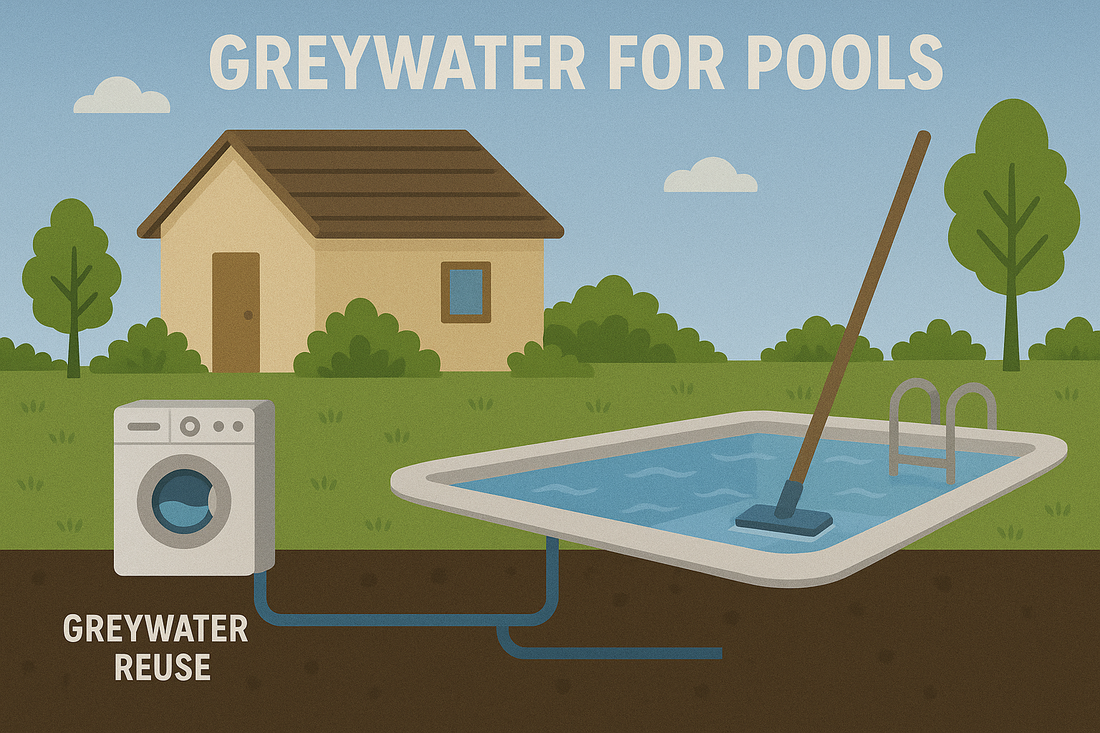
Can You Use Recycled Greywater for Pool Maintenance?
Mason LogueThe short answer is that greywater has one legitimate job around a swimming pool, and it is watering the planting that surrounds it. Greywater cannot be used to fill or top off a pool, and it should not be used to wash decks, hose patios, spray furniture, or supply an outdoor shower or foot rinse. Those are all surface and human contact uses, and greywater codes do not allow them. What greywater does well is feed the hedges, ornamental grasses, and shade trees around the pool through subsurface drip lines, which is often the thirstiest part of the yard.
What Greywater Is
Greywater is gently used water from showers, bathroom sinks, and laundry. It is not sewage, but it is not clean water either. It carries soap, lint, hair, skin cells, and enough dissolved organic material to support bacterial growth. That is the reason the codes treat it the way they do.
Why Poolside Landscaping Is Worth Watering With It
According to the U.S. Environmental Protection Agency, outdoor use accounts for nearly 30 percent of total household water consumption, and considerably more in hot, dry regions. Read the EPA breakdown at epa.gov/watersense/how-we-use-water. A pool surround is usually planted with the highest water demand vegetation on the property, so it is a sensible place to send a daily supply of laundry and shower water instead of drawing on the tap.
What the Codes Actually Allow
The greywater provisions of the Uniform Plumbing Code, and California Plumbing Code Chapter 16 and 16A, restrict residential greywater to subsurface application. Three conditions run through all of them:
- The water has to be discharged below the surface, under mulch or soil
- No ponding and no runoff are permitted
- There must be no human contact with the water
Pressure washing a deck fails all three at once. It puts greywater on a hard surface, creates runoff, and aerosolises the water so that anyone nearby breathes it. Hosing a patio, spraying cushions, and rinsing a foot station fail on the same grounds. Adoption of these code provisions varies by state and county, so check the rules in your state before you plan a system.
Irrigating the Planting Around a Pool
This is the use that works, and it is worth doing properly.
Choose the Right Plants
- Ornamental grasses, privacy hedges, shrubs, and established trees all handle greywater well
- Salt sensitive and acid loving plants, including azaleas, rhododendrons, and blueberries, do poorly with laundry water
- Keep greywater away from root crops and anything else you eat raw
Distribute It Below the Surface
Greywater has to reach the root zone without surfacing. In practice that means mulch basins fed by a distribution line, or a purpose built greywater drip field with emitters buried under mulch. Our guide to greywater for drip irrigation covers emitter spacing, line depth, and how to zone a yard so that every branch gets water.
Keep the Water Moving
Greywater is meant to be used the day it is produced. Do not plumb it into a holding tank and save it for the weekend. Untreated greywater held beyond 24 hours goes anaerobic and starts to smell, which is why the codes prohibit it. We explain the mechanism and the time limit in can I store greywater.
Never Put Greywater in the Pool Itself
Filling or topping off a pool with greywater is off the table. The organic load feeds algae, disrupts chemistry, and consumes sanitiser, and the water is in continuous human contact by definition. Fill the pool from the potable supply and use greywater on the plants instead.
What an Aqua2use System Does and Does Not Do
The Aqua2use GWDD collects greywater from laundry, showers, and bathroom sinks, runs it through progressive Matala filtration, and pumps it out to irrigation. The Aqua2use Pro does the same job at higher flow for larger homes and light commercial sites.
It is worth being precise about what that filtration is. Matala progressive filtration is mechanical filtration, not disinfection. It strips out lint, hair, and suspended solids so the water will not clog drip emitters or foul the pump. It does not sterilise the water and it does not remove pathogens. That is exactly why the output still belongs below the surface.
The GWDD tank is a vented diversion tank rather than a sealed vessel. It is designed to pass water through, not to store it, and it includes an overflow path back to the sewer or septic line for the times when irrigation demand is lower than household output.
Maintenance
Rinsing the filters every four to six months is a reasonable general guideline, but the real interval depends on your household. A large family, frequent laundry loads, long hair, or heavy detergent use will all shorten it. Check the filters after the first month, see what they look like, and set your own schedule from there. Replacement Matala filters are available when the media is past cleaning.
Setting a System Up
- Size the system to your household flow. The GWDD suits most homes, and the Pro handles larger properties, schools, and commercial sites
- Connect it to laundry, shower, and bathroom sink drains, and leave kitchen and toilet lines out
- Run the filtered output to a subsurface irrigation zone in the poolside planting
- Fit a diverter valve so you can send flow back to the sewer or septic system during heavy rain or when the beds are saturated
- Switch to low sodium, low boron, biodegradable detergents, because what goes down the drain ends up in the soil
For pool care itself, Sunset Pool Solutions offers professional service and advice on eco-friendly practices for homeowners in Georgia and Florida.
Common Questions
Can I use greywater to refill my swimming pool?
No. It adds organic load that feeds algae and consumes sanitiser, and pool water is in constant human contact.
Can I pressure wash my deck with filtered greywater?
No. Pressure washing produces runoff and aerosol, both of which greywater codes prohibit. Use it below the surface in the planting instead.
Is greywater irrigation legal where I live?
Most states allow subsurface residential greywater, and several allow simple laundry to landscape systems with no permit at all. Requirements vary widely, so check your state's rules first.
Will it smell?
Not if the water keeps moving and goes into the soil the same day. Odour comes from holding untreated greywater long enough for bacteria to use up the dissolved oxygen.
What about bleach and harsh cleaners?
Keep chlorine bleach, boron, and high phosphate detergents out of the greywater stream. Choose soaps labelled biodegradable and low sodium.
The Practical Case for Greywater at a Pool
A pool surround is a water hungry piece of landscape sitting next to a house that produces greywater every day. Connecting the two is a real saving. The honest limit is that greywater belongs in the soil and not on the deck, the furniture, or the swimmers, and a system built around subsurface irrigation delivers the benefit without stepping outside the code.


